
Find the relevant material
Page detection, ink screening and frame selection establish where the examination begins.
THE ADMISSIBLE AI ENGINE
Specialist comparison models, structured explanations and forensic signal analysis work together—connecting the question, the source and the output.
PURPOSE-SPECIFIC PROCESSING
Select an evidence walkthrough to see these roles in context.
Page detection, ink screening and frame selection establish where the examination begins.
Visual descriptions, measured geometry, sound characteristics and file records expose different signals.
Purpose-specific comparisons, calibrated evidence measures and defined checks address the selected question.
Attach regions, references, timestamps and processing context to the resulting exhibit.
01 / SPECIALIST CAPABILITIES
The engine combines learned comparison, objective measurement, signal processing and file-integrity checks. Each contributes a different kind of evidence.
Explore visual signature relationships, handwriting authorship evidence and voice characteristics with outputs appropriate to each comparison.
Connect image-quality assessment, independent specimen descriptions and systematic feature tables to the measured evidence.
Create confidence-marked speech drafts and screen supported visual patterns for specific manipulation or generation indicators.
Measure captured motion, writing geometry, recording continuity, frame timing and calibrated scene relationships.
Read file structure and embedded records, inspect content fingerprints and verify available signed provenance manifests.
Reduce noise or adjust contrast and level with captured information, producing distinct image, audio or video working copies.
A workflow can combine several learned components, reuse a shared component or rely on deterministic measurements alone. Analysis counts and unique model counts describe different things.
02 / FOLLOW THE QUESTION
Choose an evidence category to follow a representative processing path. These illustrations explain workflows; they do not process or assess uploaded files.
SIGNATURES / REPRESENTATIVE PATHWAY
A questioned signature and suitable independently sourced references. PDF and image support depends on the chosen comparison.
Separate questioned material from the reference set. Check format, visible detail and reference availability.
Measure visual relationships with complementary comparators and, where supported, account for variation among known signatures.
Keep descriptive similarity, independent distance and calibrated evidence outputs distinct, with the reference context retained.
Visual likeness does not reconstruct writing pressure or speed. Those measurements require genuine digitizer data.
HANDWRITING / REPRESENTATIVE PATHWAY
Questioned and known writing, or samples from at least two candidate writers for candidate ranking.
Extract writing structure and record supported geometry, spacing and stroke characteristics.
Run the chosen authorship or candidate-ranking workflow, retaining the appropriate comparison output.
Describe samples independently, organise observed differences and consider competing authorship explanations.
Candidate ranking is closed-set and returns a nearest candidate. Authorship evidence depends on the comparison population and validation scope.
DOCUMENTS / REPRESENTATIVE PATHWAY
Original supported files, page images, or purpose-made raking-light and transmitted-light photographs.
Read supported embedded metadata and check document-history inconsistencies.
Locate signature candidates and link each crop to its document page.
Apply suitable enhancement to captured indentation or watermark signals, or decode eligible printer marks.
Metadata is editable. Raking light, transmitted light and eligible printer marks are separate capture requirements; ordinary scans cannot supply every signal.
IMAGES / REPRESENTATIVE PATHWAY
An original image, a defined question and suitable native-resolution references for camera-pattern comparison.
Match the question to duplication, compression, source characteristics, geometry or provenance.
Produce suitable region maps, correspondence points, source-comparison measurements or manifest checks.
Retain the original and show how the selected output relates to the suspected region or source claim.
Compression workflows need a suitable JPEG history. Missing provenance is inconclusive; statistical screening and cryptographic verification answer different questions.
AUDIO / REPRESENTATIVE PATHWAY
Original audio or a supported video audio track; known material is needed for a comparison.
Keep original audio distinct from any listening copy and inspect the available recording information.
Choose confidence-marked transcription, voice similarity, shared-content comparison or continuity analysis.
Keep uncertain words visible and connect comparison scores or continuity traces to their recording context.
A raw voice-similarity score is not a calibrated identity conclusion. Hum continuity needs a detectable trace; transcription uses the original recording.
VIDEO / REPRESENTATIVE PATHWAY
Original video; camera references, timing anchors or scene calibration when the selected workflow requires them.
Inspect container properties, encoded structure and the decoded frame/timestamp record.
Choose full-sequence timing checks, sampled screening, camera alignment or calibrated measurement.
Keep source timing, sampling coverage, uncertainty and derived viewing copies visible in the output record.
Sampled screening does not examine every frame. Speed and geometric measurements need suitable source timing and calibration.
SPECIALIST TOOLS / REPRESENTATIVE PATHWAY
Suitable original image or video files, with source history, timing anchors or physical calibration as required.
Identify an encoding, recapture, multi-camera timing or motion-analysis question.
Inspect supported encoding families, local statistics, timing relationships or codec-level motion information.
Preserve reference coverage, timing uncertainty and the technical context needed to understand the result.
These specialist tools connect to the corresponding image or video workflows. Compatible formats, reference coverage and codec support vary by method.
HOW THE ANALYSIS WORKS
Fictional document for a guided workflow.
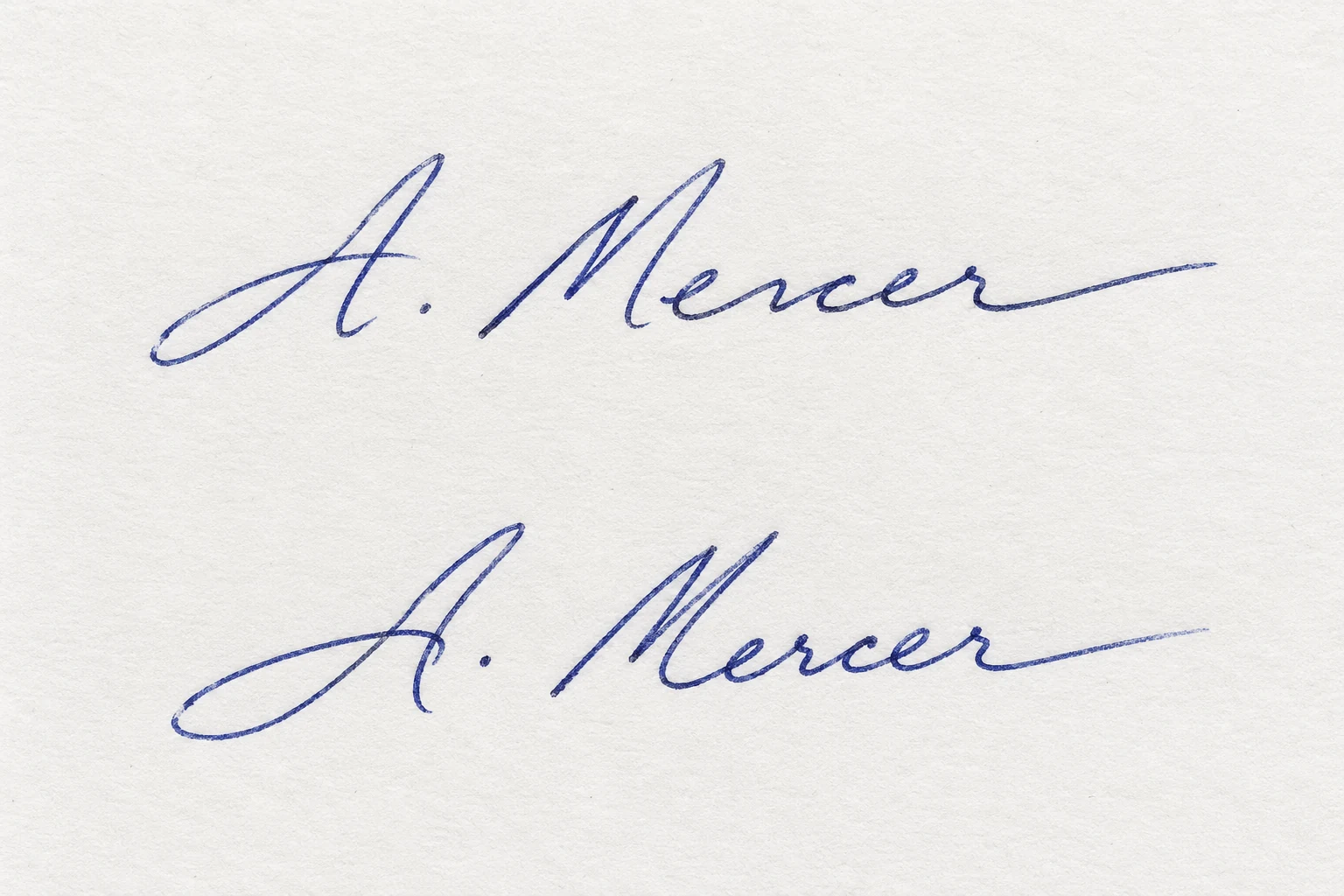
Detection & extraction / IN PRACTICE
A signature on an agreement
Keep the source page and its position in the document. Supported page rendering can produce a 600 dpi export; the original capture determines the detail available.
Locate signature-shaped regions. The wider mark-extraction workflow also screens ink and ranks candidates such as initials, names and company chops.
Reduce surrounding whitespace around the selected ink region. Keep the original page available alongside the extracted specimen.
Compare the extracted sample with references where supported. Retain the crop-to-page relationship with the comparison and report exhibit.
Demonstration material · annotations explain the workflow; no case result is calculated.
03 / FROM MEASUREMENT TO EXPLANATION
In the handwriting-comparison workflow, structured visual reasoning connects independent observations and alternative explanations to the computed comparison evidence.
Identify whether the available writing is suitable for a meaningful visual description.
Document each specimen’s visible characteristics before bringing the samples into direct comparison.
Organise letterforms, spacing and other observed agreements or differences systematically.
Explore common authorship, disguise, coincidental similarity, reuse and image artifacts as relevant explanations.
State whether the explanation agrees or disagrees with the computed evidence; do not invent an authenticity percentage.
04 / UNDERSTAND THE OUTPUT
The output format follows the question. A similarity value, a diagnostic map and a signed provenance record are not interchangeable answers.
Descriptive similarity and raw distances describe a measured relationship. Calibrated likelihood ratios, where available, express relative support under specified propositions.
Region maps, sampled image scores and continuity flags highlight a specific pattern or inconsistency within the method’s stated coverage.
Content fingerprints and available signed manifests address technical integrity or recorded provenance, rather than deciding whether everything depicted is true.
Geometry, timing and pressure retain their capture and calibration context. Clarified copies remain distinct from the originals.
05 / REFERENCES & FURTHER READING
Independent technical reading on evaluation, evidential weight, media processing and provenance. Platform-specific scope and validation are documented separately.
Background on evaluating AI trustworthiness, validity and reliability. Useful for understanding why performance must be measured for the intended use.
Read the reference (opens a new tab)www.nist.govExplains how findings can be evaluated under competing propositions and why evidential weight differs from a probability that a proposition is true.
Read the reference (opens a new tab)enfsi.euBackground on recording quality, repeatable processing and the relationship between enhancement goals and the signal actually present in a recording.
Read the reference (opens a new tab)www.swgde.orgA technical overview of video examination, file handling, timing, clarification and the documentation of derived material.
Read the reference (opens a new tab)www.swgde.orgExplains how signed provenance records describe content history. This is a different question from whether the depicted event or a statistical screening result is correct.
Read the reference (opens a new tab)c2pa.orgReferences explain the underlying concepts; their inclusion does not indicate product certification, endorsement or validation by the publishers.
06 / ENGINE QUESTIONS
No. Some workflows combine multiple learned components, others reuse shared components, and deterministic checks do not require a learned model. A count of analyses is not a count of unique deployed models.
The handwriting workflow can assess image suitability, describe specimens independently, organise a feature table, consider alternative explanations and relate its explanation to the computed comparison output.
No. Outputs include descriptive similarity, evidential-weight measures, raw comparison values, diagnostic maps, timing records, verified provenance information and separate clarified copies. The selected workflow defines what an output means.
The described enhancement workflows use non-generative processing with information already captured in the original. They produce separate image, listening or viewing copies rather than reconstructing missing detail.
Each module page describes the supported inputs, output type and technical scope. Research and validation resources document the available evidence separately from the external background references linked above.
YOUR EVIDENCE. A FOCUSED WORKFLOW.
Explore the capabilities around the questions your team investigates.