
Compare authorship
Weigh questioned writing against known exemplars with a measured likelihood ratio and structured visual reasoning.
Explore common-authorship comparison ↗HANDWRITING COMPARISON SOFTWARE
Compare handwriting samples, explore candidate writers and measure slant, spacing, baseline and stroke features with forensic handwriting analysis software.
Explore measured writing features, structured visual comparisons and candidate rankings with defined output types.
Inspect visible loops, connections and proportions. Consider similarities alongside natural variation.
Select a feature or play the illustration.
01 / THE QUESTION DETERMINES THE METHOD
Start with the examination question. Comparing authorship, ranking candidate writers and recording measurements require different inputs and interpretations.
Weigh questioned writing against known exemplars with a measured likelihood ratio and structured visual reasoning.
Explore common-authorship comparison ↗Rank two or more known candidates and examine the gap between the nearest and second-nearest.
Explore writer ranking ↗Record baseline, slant, spacing and line-quality indicators without turning them into an authenticity verdict.
Explore screening & measurements ↗HOW THE ANALYSIS WORKS
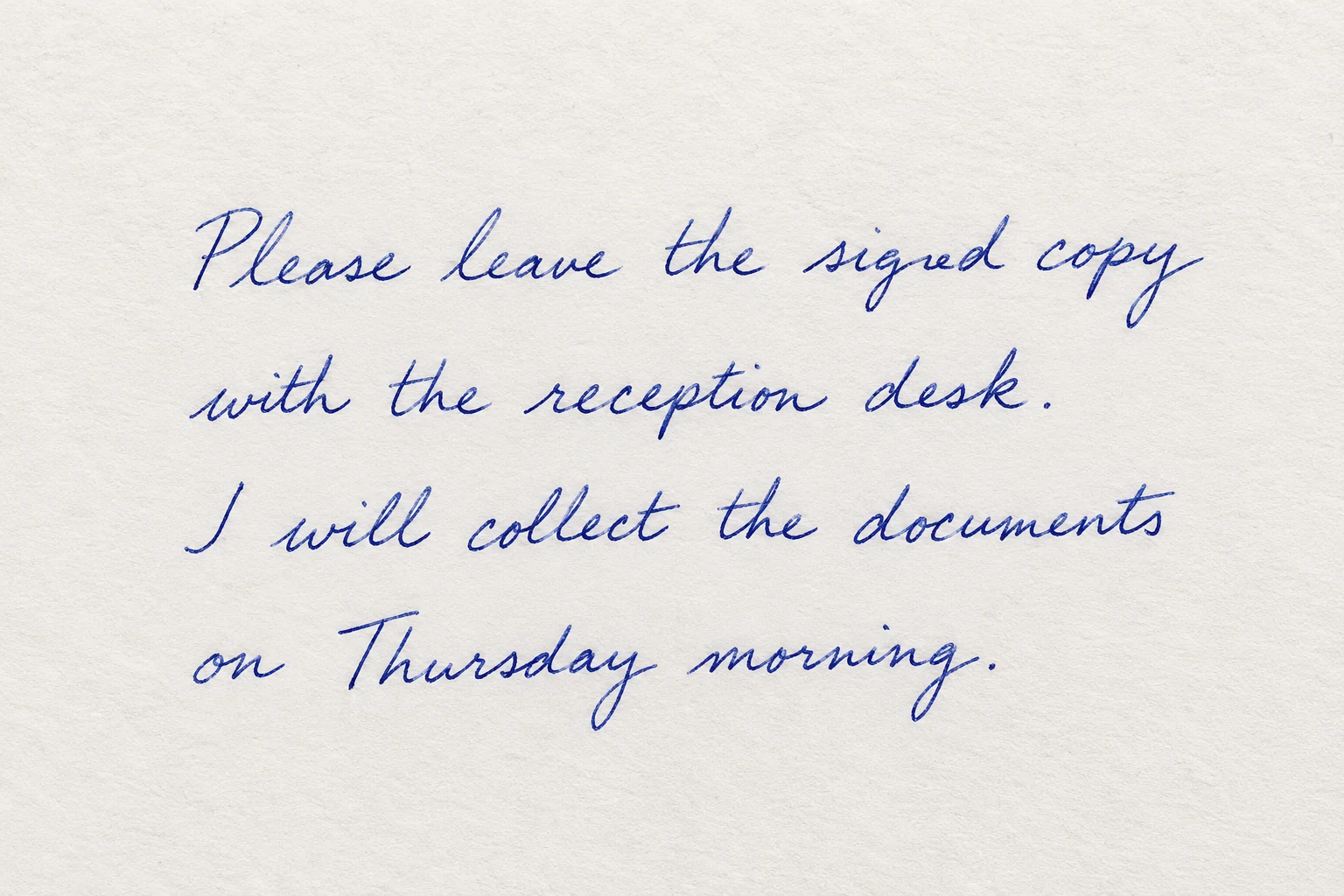
Handwriting / IN PRACTICE
A questioned note and known writing
Use legible writing and appropriate references. A candidate-writer search needs samples from the supplied candidate writers.
Extract structural writing units and measure supported baseline, slant, component dimensions, spacing and stroke width.
Common-authorship comparison evaluates sample relationships statistically. Candidate ranking compares local writing features to shortlist the nearest supplied writers.
Organise feature measurements and line-quality indicators alongside the selected comparison output. Each answers a different part of the writing question.
Demonstration material · annotations explain the workflow; no case result is calculated.
02 / CAPABILITIES, EXPLAINED
See what each workflow examines, what it needs and how to interpret the result. Expand a workflow for inputs, features and limitations.
Compare a questioned writing sample with a known exemplar using measured writing features and an independent visual review.
What you receive: A score-based likelihood ratio, an evidence table and a plain-language explanation.
Questioned writing and at least one known writing exemplar.
A likelihood ratio weighs evidence under defined hypotheses; it is not a probability that a person is the author. Strength depends on the reference population used in development. Script-independent processing does not establish equal validation across every language.
Compare an anonymous or questioned sample against writing from several candidate writers.
What you receive: An ordered candidate list and the nearest-versus-second-nearest similarity margin.
Questioned writing and known samples from at least two candidate writers.
This is a closed-set ranking: it always identifies a nearest candidate, even if the actual author is absent. A small margin warrants caution; the ranking is not an authorship verdict.
Screen one handwriting or signature image for visible mechanical features that may warrant closer examination.
What you receive: Raw measurements of tremor, terminals, disconnected components and local stroke-width outliers.
One questioned writing or signature image.
A single-image screening tool, with no reference comparison or genuine/forged verdict. Disconnected ink components do not by themselves prove physical pen lifts. Image quality and processing artifacts can affect the indicators.
Document visible baseline, slant, component dimensions, spacing and stroke width from one writing sample.
What you receive: Per-line measurements, with angles in degrees and dimensions in pixels.
One handwriting sample image.
No DPI is assumed, so pixel measurements are not converted into physical units. Curvature descriptors and dot/diacritic locations are not assessed. No writer-normal range, reference comparison or authenticity verdict is supplied.
03 / TRADITIONAL + ASSISTED EXAMINATION
Measure writing features, compare reference variation and organise the resulting outputs in one workflow.
| Examination task | Traditional examination | With Admissible assistance |
|---|---|---|
| Sample suitability | Inspect source quality, provenance and whether enough comparable writing is available. | A structured assessability review supports the same suitability decision; poor material still limits the examination. |
| Authorship comparison | Inspect letterforms, spacing, connections and natural variation, then weigh competing explanations. | Add measured likelihood-ratio evidence and a systematic visual evidence table. |
| Candidate selection | Compare candidate writers individually and organise similarities and differences. | Rank candidates and inspect the nearest-versus-second-nearest margin; the actual author may be absent. |
| Measurements & screening | Manually record baseline, slant, dimensions and possible simulation indicators. | Quantify visible geometry and line-quality signals, with fit checks and explicit unassessed features. |
| Time & cost | Preparation, comparison, measurement, reasoning and reporting require working time. | May reduce repetitive measurement and organisation. Input preparation, checking, review and fees also count. |
| Accuracy & final opinion | Depends on evidence quality, comparable material, reference suitability and suitable methods. | Provides additional signals, not a guaranteed accuracy increase. Validation limits and conflicting outputs require human assessment. |
Traditional examination may already use digital tools. This comparison describes workflow roles, not a claim that manual practice is inferior or that assisted outputs are automatically correct.
TIME & COST / YOUR OWN ESTIMATES
Enter the total working hours you expect for each approach, including preparation, checking, interpretation and reporting. Include additional assisted-workflow fees.
Time saved is not evidence of better accuracy. Assess each workflow’s tested population, failure modes and suitability for the actual questioned material.
Traditional: US$1,200 · Assisted: US$850
Example assumptions only. These are not measured platform savings, quoted fees or a performance guarantee.
04 / A TRACEABLE PROCESS
Preserve the source and make the reasoning traceable. Choose the analysis only after confirming the examination question and input requirements.
Retain the source, document provenance and select independently sourced known references.
Match the question to authorship comparison, candidate ranking, line quality or objective measurements.
Inspect the source alongside outputs. Consider conflicts, limitations and alternative explanations.
Document observations, measurements, source links and processing history in the result record.
START WITH THE EVIDENCE YOU HAVE
A questioned sample, known exemplars and clear source records are the starting point.